
From Home Builder Magazine, May, 2000
By Sandra Graham, Photographs By Phil Mumford
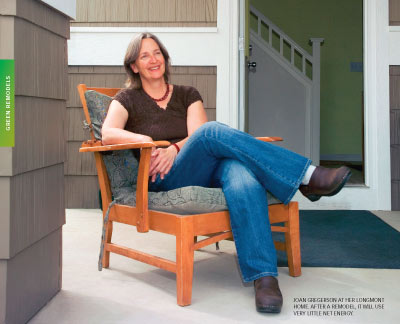
Joan Gregerson has promoted the value of sustainability for years. This year, the Longmont electrical engineer has put her money where her mouth is. She is transforming her modest 1995 tract house into a highly energy-efficient dwelling
– a “darn-near-zero energy home,” as she puts it.
“I’ve been telling everybody to do this,” says Gregerson, who has worked for an energy management software firm and consulted for the Governor’s Office of Energy Management and Conservation during her career. “It’s a great investment and compared to other things you can do with money, it’s a smart thing to do. I thought maybe it’s just time for me to do it.”
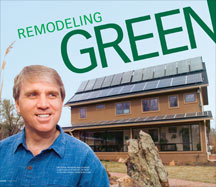
To reach the near-zero energy level – where energy use and energy generation even out – Ecofutures Building Inc. will revamp Gregerson’s 1,500-square-foot home this summer with spray-foam isonene insulation, new south-facing windows for winter warmth, solar thermal panels, some highefficiency replacement windows, energy- and water-efficient appliances and other elements. Later, Ecofutures will add photovoltaic (PV) cells so Gregerson can generate electricity and sell any surplus to her local utility. First-phase costs, she says, are $50,000 – “roughly the cost of a Hummer.””
Gregerson’s home is one of two that Ecofutures is remodeling this summer with an environmentally friendly – or “green” – approach. Eric Doub, Ecofutures’ president and founder, also has built entire green homes, including his own. And he incorporates green elements into every project, large or small, that his company undertakes.
“We create homes that will be useful 50 years from now … when energy bills are more than mortgages,” says the Boulder builder. But his environmentally benign approach doesn’t only ensure energy efficiency. Dwellings are comfortable, healthy, durable and valuable. That, he says, is what green remodeling and building deliver.
More customers are asking for green remodels, says Doug Parker, president of Boulder’s Bighorn Builders, who built his first solar home 30 years ago. “They’re interested in doing the right thing or they’ve read about it. They think it’s preparing their home for the future and making it healthier,” Parker explains. Nationally, a recent survey of remodelors by the National Association of Home Builders found that:
Rising energy prices, dwindling energy supplies and a desire to do something about global warming and other environmental issues are helping drive the green movement. Utilities, realizing it’s cheaper to reduce consumption of electricity and natural gas than build power plants or drill gas wells, are pushing conservation among customers.
Colorado Gov. Bill Ritter’s “Colorado Promise” promotes environmental protection and renewable energy. Commercial building owners also realize the pluses of green techniques: The historic Alliance Center in LoDo Denver, for example, was retrofitted in 2005 to save water and energy, earning a Gold Certification from the U.S. Green Building Council.
These days, it’s clear: The green gang is going mainstream. “There are some green building techniques that make a lot of sense, whether you’re green or not, because things are better-performing and better-built,” says John Happel, who along with his wife, Dilsha Anne Happel, co-owns H & H Builders LLC in Denver.
The Happels captured first place in the 2006 Colorado Awards for Remodeling Excellence for a green remodeling project at the half-century-old Boulder home of Dr. Jeremiah Kaplan, a geriatrics specialist, and his wife. Kaplan says that whatever one’s politics or beliefs, green construction “really makes a better home.”
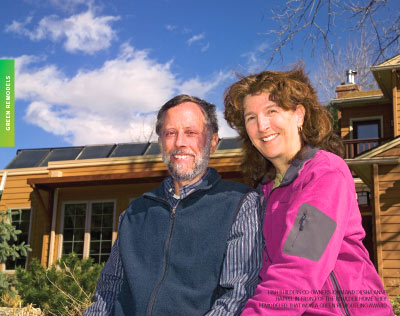
The Kaplans love the partially solar-heated home, with its new sun porch and extra bedroom, and not just because it uses only one-third the energy it did before. It’s comfortable – and attractive. “It’s much more beautiful and aesthetically pleasing than I expected,” he says.
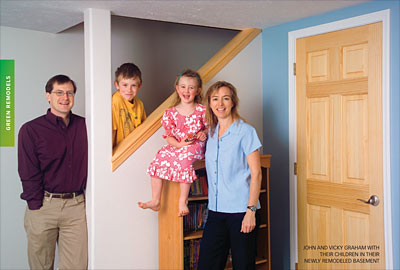
Despite the growing interest in green remodeling, some customers say finding empathetic contractors isn’t always easy. Vicky Graham, a Boulder optometrist, and her husband, John, have hired Doub to transform their 1970s brick ranch home into a zeroenergy dwelling this summer. But a few years ago, the Grahams’ search for a green contractor to add a great room to the house proved frustrating.
“When we tried to get the notion across of recycling and not using toxic stuff, if somebody didn’t come from that perspective, it was painstaking,” Graham says. A contractor “has to know the language and come from that perspective, too.”
Insulating, weatherstripping and caulking “are the most economical things you can do,” says Happel. Stopping air leaks is advisable not just in any additional square footage you’re creating, but throughout the existing structure, too. Thompson suggests attic insulation with an R-value of 49. (R-value measures thermal resistance; the higher the number, the slower heat moves through the insulation.)
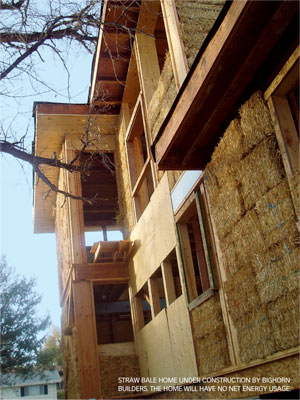
Johnston agrees insulation is a must: “Solar is sexy. Insulation is not. But insulation has the payback people expect.” (Caution: Too tight a house can cause indoor pollutants to build. Ensure ventilation is adequate.)
Not sure where to plug air leaks? Suggest that customers have their home energy-audited before the remodeling project begins, says Morey Wolfson, sustainability consultant with the architectural firm of David Owen Tryba Architects in Denver. Audits, which cost roughly $300 to $500, use fans, blower doors, infrared detectors and other tools to pinpoint energy seepage. Some audits can even monitor appliances for smart energy usage.
Expect high energy bills. Don’t put in too many windows, says Patrick Keegan, acting director of ENERGY STAR Colorado, a non-profit that advances energy efficiency in housing. Advise customers that even the best windows aren’t as good at stopping energy leaks as a solid, well-insulated wall.
If a project involves new windows, choose low-emittance (low-e) windows, which have a coating that suppresses heat flow. Low-e windows that are double-glazed with an inert gas sandwiched between the glass panes are even more energyefficient. Happel notes low-e windows have been standard on his projects for a decade. “They’re maybe 5 percent to 10 percent more expensive, but they save a lot of energy,” he says. Replacing existing windows in the rest of a dwelling can be a harder call because of the expense, but Thompson notes that new windows are a must if a home has steel- or aluminum-framed, single-pane windows, which are notorious energy sieves.
E-Star’s Keegan says remodelors should consider becoming energy specialists themselves. E-Star can train a remodelor in a little more than a week to do audits. Remodelors already have the know-how to take care of issues that audits raise. E-Star’s home performance specialist training is sponsored by the U.S. Environmentalfuel, the owner reaps the heat of plus 90 percent). Higher-efficiency furnaces can add a few thousand dollars to a project’s cost, but, again, will pay off – if the house is properly insulated to trap the heat generated, Happel says. Make sure the furnace is sized right for a home’s square footage so owners don’t end up buying and running furnaces bigger than they Protection Agency along with some Colorado utilities and municipalities. The next session is planned for this summer.
Check insulation in ceilings, walls and crawl spaces, and beef it up as needed. Thompson notes it’s easy to overlook insulating crawl spaces so that energy is wasted warming the empty space in winter and cooling it in summer. There are many types of insulation. Choose a product that is right for the space and environmentally benign.
If a project involves replacing a furnace, go for a high-efficiency model rated 90 percent or more (which means for every dollar spent on furnace fuel, the owner reaps the heat of plus 90 percent). Higher-efficiency furnaces can add a few thousand dollars to a project’s cost, but, again, will pay off – if the house is properly insulated to trap the heat generated, Happel says. Make sure the furnace is sized right for a home’s square footage so owners don’t end up buying and running furnaces bigger than they need.
Compact fluorescent light bulbs and low-energy fixtures cost more, but save up to 80 percent of a normal bulb’s energy.
While many green techniques involve energy conservation, don’t forget to consider:
“It’s good to look at all the different ways you cannot bring new synthetic products into the household – adhesives, particle board, carpet. There are alternatives for every conventional product on the market today,” Johnston says.
Some green techniques are bigger ticket items, the experts note. These include:
Electricity-generating PV cells, which can be set up on south-facing grids or roofs or incorporated into the roof itself, carry hefty tax credits these days and have dropped significantly in cost while increasing in efficiency. Still, a PV system remains costly enough to have a 10- to 20-year payoff in lower bills. “I think we’re still a few years away from it becoming an everyday type of thing,” Happel says.
Remodeling often involves tearing out and disposing of dumpsters full of unwanted materials. Some green remodelors take apart an old structure and recycle it down to the last brick and board. In Colorado, “landfill costs are so cheap, it’s really hard to justify it,” says Happel.
Still, going green isn’t a black-and-white situation. “A lot of the easy stuff pays off right away. But it’s still the right thing to do. If you’re going to stay in your house for a long time,” longer payback periods can be considered, he adds.
To Gregerson, her green home will serve as a beacon: “I just started thinking that when I die, what will I have done? If I convert one house to a zero energy home, then my 11-year-old nephew will think I’m cool. This will be one little spot that’s an example that helps other people do it.”

H & H Builders LLC
12295 Pennsylvania St, Suite 10 B
Denver, CO 80241
Tel: (303) 450-7006